Research
Diffuse Gas in and around the Milky Way
-

The Milky Way's Circumgalactic Medium
We are using ultraviolet and optical spectra of distant background sources (quasars
and other active galactic nuclei) to study the absorption of metal ions in diffuse
gas clouds in the halo of the Milky Way ("circumgalactic" gas). From this, in combination
with semi-analytic models of the gas distribution around Milky-Way type galaxies, we
obtain crucial information on the total mass of the Milky Way's circumgalactic medium
and its physical state. These studies further allow us to derive the Milky Way's
gas-accretion rate and to characterize the role of the CGM for the evolution of our
Galaxy (project leader: Philipp Richter).
-
Small-scale structure in the Milky Way's ISM
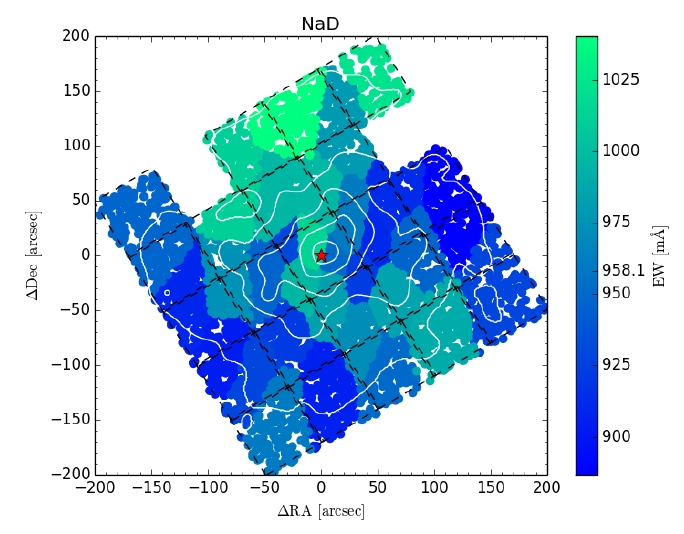
Small-scale structure in the Milky Way's interstellar medium is mapped using
VLT/MUSE data of thousands of stars in Galactic globular clusters. The method
of 3D-spectroscopy allows us to study variations in the interstellar line
strengths of optical transitions of metal ions and in diffuse interstellar
bands on linear scales of milli-pc. The MUSE data are complemented by
high-resolution spectra in the optical and in the UV from various different
instruments. Studies like these are essential to improve our understanding
of the distribution of interstellar gas at small spatial scales (project
leader: Martin Wendt).
Intergalactic and circumgalactic gas
-

The nature of intervening QSO absorption-line systems
We are mining the VLT/UVES and Keck/HIRES data archives to use high-resolution,
high signal-to-noise
optical spectra of distant quasars to systematically explore the physical
conditions intervening metal-absorption line systems at high redshift.
Multi-component Voigt profile fitting is applied to these spectra to obtain accurate
information on the metal-abudances, ionization conditions (via ionization
modeling), and incidence rate of the different absorber classes and to
determine their origins and their role in the large-scale structure formation.
In addition, column-density ratios of metal ions are systematically investigated
to set constraints to the redshift-evolution, intensity, and hardness of the
overall UV background that permeates the Universe (project leader: P. Richter).
-

-

Simulations of galaxies and their circumgalactic/intergalactic environment
We are using state-of the art cosmological, hydrodynamical simulations
(e.g., from HESTIA, TNG50), to investigate the
circumgalactic gas flow around galaxies, gas accretion processes,
and the evolution of galaxies. Our current and future focus lies on
the gas distribution in the Local Group (studied with HESTIA) and the
local Cosmic Web as well of the morphological evolution of galaxy disks
of the merging galaxies (studies with TNG50), for which we use
a sample of simulated major merger galaxies in full cosmological setups
(project leader: P. Richter).
The Milky Way's Circumgalactic Medium
We are using ultraviolet and optical spectra of distant background sources (quasars and other active galactic nuclei) to study the absorption of metal ions in diffuse gas clouds in the halo of the Milky Way ("circumgalactic" gas). From this, in combination with semi-analytic models of the gas distribution around Milky-Way type galaxies, we obtain crucial information on the total mass of the Milky Way's circumgalactic medium and its physical state. These studies further allow us to derive the Milky Way's gas-accretion rate and to characterize the role of the CGM for the evolution of our Galaxy (project leader: Philipp Richter).
Small-scale structure in the Milky Way's ISM
Small-scale structure in the Milky Way's interstellar medium is mapped using VLT/MUSE data of thousands of stars in Galactic globular clusters. The method of 3D-spectroscopy allows us to study variations in the interstellar line strengths of optical transitions of metal ions and in diffuse interstellar bands on linear scales of milli-pc. The MUSE data are complemented by high-resolution spectra in the optical and in the UV from various different instruments. Studies like these are essential to improve our understanding of the distribution of interstellar gas at small spatial scales (project leader: Martin Wendt).
Intergalactic and circumgalactic gas
-
The nature of intervening QSO absorption-line systems
We are mining the VLT/UVES and Keck/HIRES data archives to use high-resolution,
high signal-to-noise
optical spectra of distant quasars to systematically explore the physical
conditions intervening metal-absorption line systems at high redshift.
Multi-component Voigt profile fitting is applied to these spectra to obtain accurate
information on the metal-abudances, ionization conditions (via ionization
modeling), and incidence rate of the different absorber classes and to
determine their origins and their role in the large-scale structure formation.
In addition, column-density ratios of metal ions are systematically investigated
to set constraints to the redshift-evolution, intensity, and hardness of the
overall UV background that permeates the Universe (project leader: P. Richter).
-
-
Simulations of galaxies and their circumgalactic/intergalactic environment
We are using state-of the art cosmological, hydrodynamical simulations
(e.g., from HESTIA, TNG50), to investigate the
circumgalactic gas flow around galaxies, gas accretion processes,
and the evolution of galaxies. Our current and future focus lies on
the gas distribution in the Local Group (studied with HESTIA) and the
local Cosmic Web as well of the morphological evolution of galaxy disks
of the merging galaxies (studies with TNG50), for which we use
a sample of simulated major merger galaxies in full cosmological setups
(project leader: P. Richter).
The nature of intervening QSO absorption-line systems
We are mining the VLT/UVES and Keck/HIRES data archives to use high-resolution, high signal-to-noise optical spectra of distant quasars to systematically explore the physical conditions intervening metal-absorption line systems at high redshift. Multi-component Voigt profile fitting is applied to these spectra to obtain accurate information on the metal-abudances, ionization conditions (via ionization modeling), and incidence rate of the different absorber classes and to determine their origins and their role in the large-scale structure formation. In addition, column-density ratios of metal ions are systematically investigated to set constraints to the redshift-evolution, intensity, and hardness of the overall UV background that permeates the Universe (project leader: P. Richter).
Simulations of galaxies and their circumgalactic/intergalactic environment
We are using state-of the art cosmological, hydrodynamical simulations (e.g., from HESTIA, TNG50), to investigate the circumgalactic gas flow around galaxies, gas accretion processes, and the evolution of galaxies. Our current and future focus lies on the gas distribution in the Local Group (studied with HESTIA) and the local Cosmic Web as well of the morphological evolution of galaxy disks of the merging galaxies (studies with TNG50), for which we use a sample of simulated major merger galaxies in full cosmological setups (project leader: P. Richter).